ERP Integration Guide for FBR Digital Invoicing in Pakistan
As Pakistan accelerates its digital tax transformation, businesses are increasingly required to integrate their Enterprise Resource Planning (ERP) systems with the Federal Board of Revenue (FBR) Digital Invoicing platform. Whether you operate in manufacturing, pharmaceuticals, distribution, retail, wholesale, or import/export, ERP integration enables automated invoice submission, real-time validation, and improved compliance.
This guide explains the ERP integration process, legal framework, technical requirements, implementation steps, and best practices for complying with FBR Digital Invoicing requirements.
What is ERP Integration?
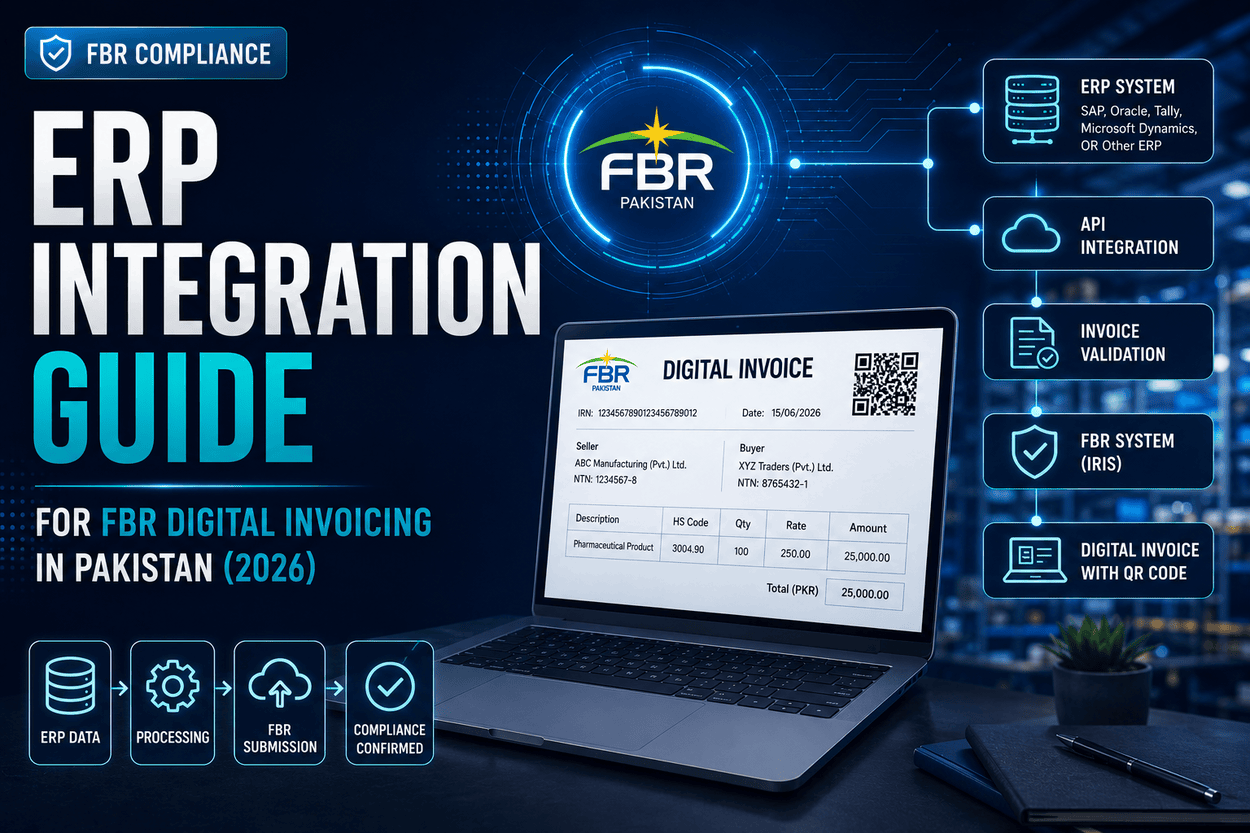
Enterprise Resource Planning (ERP) integration connects your business management software with external systems to automate the exchange of data.
For FBR Digital Invoicing, ERP integration enables your software to:
- Generate electronic tax invoices.
- Transmit invoice data electronically to FBR.
- Receive invoice validation responses.
- Store Invoice Reference Numbers (IRNs), where applicable.
- Maintain secure digital records for compliance.
Instead of manually uploading invoices, your ERP automates the entire reporting process.
Why ERP Integration is Important
Manual invoicing increases the risk of errors, delays, and compliance issues.
ERP integration helps businesses:
- Automate invoice reporting.
- Improve operational efficiency.
- Reduce manual data entry.
- Eliminate duplicate invoices.
- Strengthen tax compliance.
- Improve inventory management.
- Enable real-time financial reporting.
- Simplify audits and recordkeeping.
Legal Framework
ERP integration for Digital Invoicing is supported by Pakistan’s sales tax legislation.
Sales Tax Act, 1990
The Act empowers FBR to prescribe electronic invoicing requirements and compliance obligations for notified registered persons.
Sales Tax Rules, 2006
The Rules prescribe procedures for issuing, transmitting, and maintaining electronic sales tax invoices.
Rule 150Q
Rule 150Q establishes the legal basis for electronic invoice generation and transmission by notified registered persons.
Businesses within scope are required to integrate their invoicing systems and comply with the prescribed technical standards.
Latest Regulatory References
The Digital Invoicing framework is supported by:
- S.R.O. 69(I)/2025 – Introduced the Electronic Invoicing framework and Rule 150Q.
- S.R.O. 709(I)/2025 – Introduced phased mandatory Digital Invoicing.
- S.R.O. 1413(I)/2025 – Expanded mandatory compliance to additional categories of registered persons.
- Sales Tax General Order No. 01 of 2026 – Issued implementation guidance, invoice correction procedures, and operational requirements.
ERP Systems That Can Be Integrated
NatureTech supports integration with a wide range of ERP and accounting platforms, including:
- SAP
- Oracle
- Microsoft Dynamics 365
- Odoo
- Oracle NetSuite
- Sage
- TallyPrime
- QuickBooks (Enterprise implementations)
- ERPNext
- Microsoft Business Central
- In-house ERP solutions
- Custom-developed accounting software
Our integration approach is tailored to your existing software architecture and business workflows.
How ERP Integration Works
Step 1: Business Assessment
Review your invoicing process, ERP capabilities, and compliance requirements.
Step 2: API Configuration
Configure secure API connectivity between your ERP and the FBR Digital Invoicing platform.
Step 3: Data Mapping
Map ERP fields—such as customer details, tax information, product codes, quantities, prices, and invoice totals—to the required Digital Invoicing format.
Step 4: Validation Testing
Perform end-to-end testing to verify that invoices are generated, transmitted, and validated successfully.
Step 5: Production Deployment
Enable live invoice reporting and monitor transaction status to ensure ongoing compliance.
Key Features of ERP Integration
An effective ERP integration should provide:
- Automated invoice generation
- Real-time electronic submission
- Invoice validation
- Error handling and retry mechanisms
- Secure data transmission
- Audit logs
- User access controls
- Dashboard and reporting
- Status monitoring
- Integration with inventory and finance modules
Benefits of ERP Integration
By integrating your ERP with FBR Digital Invoicing, your business can achieve:
- Reduced manual effort
- Faster invoice processing
- Improved data accuracy
- Better compliance
- Reduced operational costs
- Enhanced audit readiness
- Centralized financial data
- Improved customer service
- Scalability for business growth
Common Integration Challenges
Businesses may encounter:
- Legacy ERP systems
- Incomplete master data
- Custom workflows
- Network security requirements
- Data mapping inconsistencies
- User training needs
- Change management
A structured implementation plan and experienced integration partner can help mitigate these challenges.
Best Practices
To ensure a successful implementation:
- Update your ERP to the latest supported version.
- Clean and validate master data.
- Test integration thoroughly before going live.
- Train finance and IT teams.
- Monitor integration logs and validation responses.
- Implement role-based access controls.
- Maintain regular backups.
- Stay informed about updates to FBR requirements.
Industries That Benefit from ERP Integration
ERP integration is valuable across multiple industries, including:
- Manufacturing
- Pharmaceuticals
- Distribution
- Wholesale
- Retail
- Import & Export
- Healthcare
- Automotive
- Food & Beverage
- Textile
- Chemicals
- Consumer Goods
Why Choose NatureTech?
NatureTech delivers secure, scalable ERP integration solutions for FBR Digital Invoicing.
Our services include:
- ERP Integration
- FBR Digital Invoicing Integration
- API Development
- Custom Middleware Solutions
- Data Mapping
- Testing & Deployment
- User Training
- Technical Support
- Ongoing Compliance Assistance
We work closely with your IT and finance teams to ensure a seamless implementation with minimal disruption to business operations.
Frequently Asked Questions
Can my existing ERP be integrated?
Yes. Most ERP and accounting systems can be integrated with the FBR Digital Invoicing platform through secure APIs or custom middleware.
Is ERP integration mandatory?
Businesses covered by FBR’s Digital Invoicing framework must ensure their invoicing systems meet the prescribed technical and legal requirements.
How long does implementation take?
Implementation timelines depend on the ERP system, level of customization, and business processes. A technical assessment can provide a project estimate.
Will ERP integration interrupt business operations?
With proper planning, testing, and phased deployment, integration can usually be completed with minimal disruption.
Does NatureTech provide post-implementation support?
Yes. We offer ongoing technical support, monitoring, maintenance, and assistance with future regulatory updates.