FBR Sales Tax Changes in Finance Act 2026-27: What Pakistani Businesses Need to Know
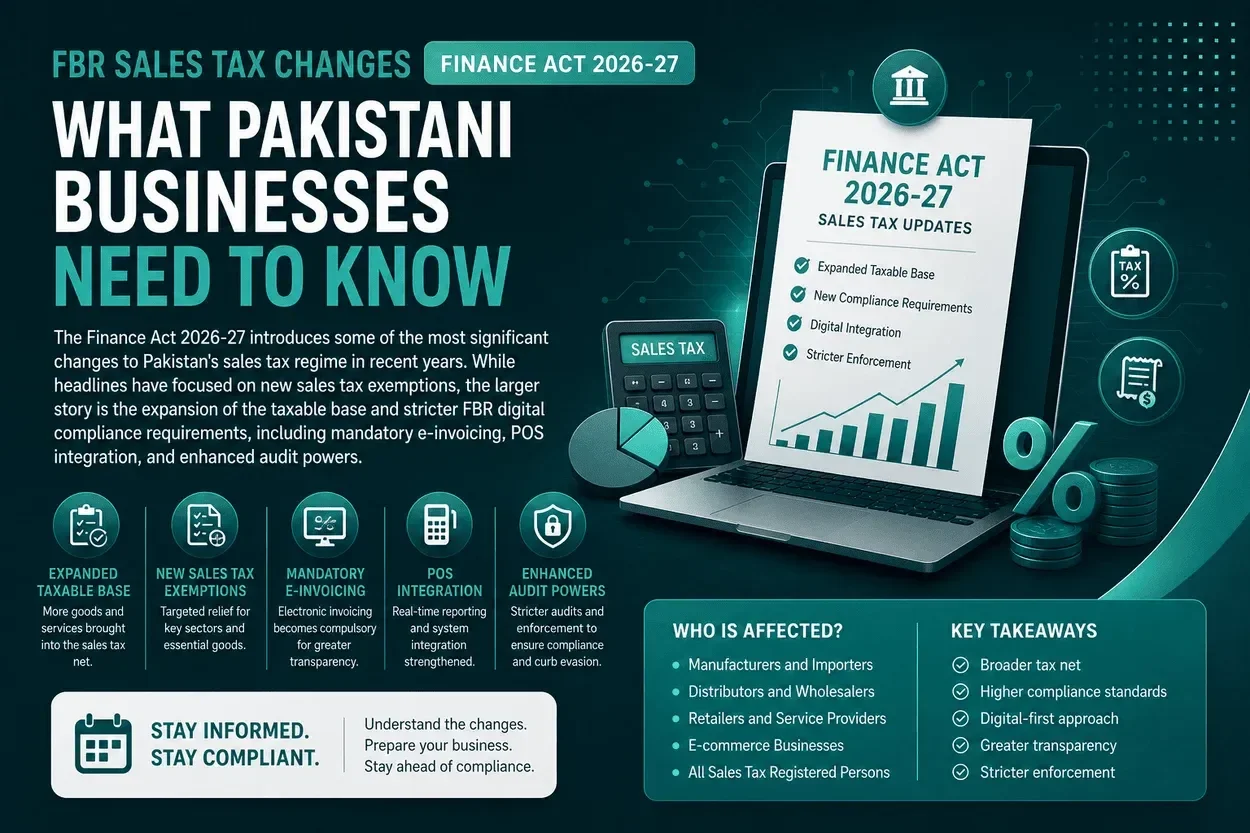
The Finance Act 2026-27 introduces some of the most significant changes to Pakistan’s sales tax regime in recent years. While headlines have focused on new sales tax exemptions, the larger story is the expansion of the taxable base and stricter FBR digital compliance requirements, including mandatory e-invoicing, POS integration, and enhanced audit powers.
If you’re a Pakistani manufacturer, retailer, wholesaler, or SME, understanding these changes is essential to avoid penalties and remain compliant with Federal Board of Revenue (FBR) regulations.
Also Read: Complete Guide to FBR e-Invoicing in Pakistan
The Taxable Base Has Expanded
Although the Finance Act introduces several targeted exemptions, the overall direction is clear: more products are now subject to sales tax compliance.
The Finance Bill 2026 expands the Third Schedule of the Sales Tax Act, bringing additional products under the retail-price-based taxation system at the standard 18% sales tax rate.
Newly covered product categories include:
- Edible oils and ghee
- Confectionery
- Sauces and condiments
- Footwear
- Sanitary ware
- Plastic products
- Cosmetics
- Household utensils
- Ceramic products
FBR has also proposed adding 21 additional categories, including packaged food, beverages, cosmetics, insecticides, and various household goods.
For manufacturers, this means retail prices must be printed at the manufacturing stage, affecting packaging, invoicing, ERP workflows, and POS systems.
Learn more from the
Federal Board of Revenue (FBR).
New Sales Tax Exemptions Introduced
Despite broader taxation, several sector-specific exemptions have been introduced.
- Contraceptives and female sanitary products
Newly exempt from sales tax to improve accessibility. - Electric vehicle (EV) imports
Specified EV imports continue receiving sales tax exemptions to encourage green transportation. - Aircraft imports and leasing
Parliament expanded the previous PIA-specific concession to include aircraft leasing and related parts more broadly. - Bulletproof vehicles and maritime vessels
Limited exemptions apply for government, security agencies, and qualifying cargo vessels. - Cancer treatment APIs, agricultural machinery, and construction equipment
Eligible for customs duty exemptions under the government’s tariff rationalization initiative.
Unless your business operates within one of these industries, the Finance Act is more likely to affect your compliance obligations than your tax liability.
The Biggest Change: Digital Enforcement by FBR
The most important takeaway for businesses is the government’s continued shift toward digital tax enforcement.
1. Mandatory FBR Integration
Businesses that fail to integrate with FBR’s electronic invoicing or production monitoring systems may now face suspension or blacklisting instead of ordinary monetary penalties.
2. Expanded Tier-I Retailer Criteria
The definition of Tier-I retailers has widened through revised turnover-based criteria, bringing more businesses under mandatory POS integration.
3. National Faceless Centre
Sales tax audits and assessments are expected to move toward a centralized electronic process through the proposed National Faceless Centre.
4. Stronger Anti-Fraud Measures
- Public register of suspicious invoice issuers
- Input tax credit may be denied where purchases involve fictitious suppliers.
- Greater scrutiny of supplier verification.
5. Mandatory Electronic Invoicing for FED
Businesses dealing in excisable goods must also comply with mandatory electronic invoicing requirements under Federal Excise Duty.
Read the latest tax laws on the
official FBR legislation portal.
What Pakistani Businesses Should Do Now
- Confirm whether you’re now classified as a Tier-I retailer.The updated criteria may require your business to integrate with FBR even if you were previously exempt.
- Review your ERP, POS, and invoicing systems.Ensure they support electronic invoicing, supplier validation, and FBR integration.
- Verify suppliers before claiming input tax.Supplier legitimacy is becoming increasingly important under the revised compliance framework.
- Don’t rely on exemptions without verification.Most exemptions remain industry-specific and should be reviewed carefully.
- Implement compliance before enforcement begins.Waiting until receiving an FBR notice may expose your business to avoidable penalties.
Related Reading: How FBR POS Integration Works for Retail Businesses
Related Reading: Complete Guide to FBR IRIS API Integration
How NatureTech Helps Businesses Stay FBR Compliant
NatureTech is a licensed FBR integrator offering ERP, POS, e-invoicing, and IRIS API integration solutions that help businesses comply with evolving tax regulations.
Whether you’re unsure about Tier-I retailer requirements or need assistance implementing FBR integration, our compliance specialists can review your existing setup and identify potential risks before they result in penalties.
Contact NatureTech today to review your FBR compliance status.
Frequently Asked Questions (FAQs)
Who needs FBR e-invoicing under the Finance Act 2026-27?
Businesses falling under the revised Tier-I retailer criteria or those dealing with specified taxable goods may now require mandatory electronic invoicing and POS integration.
Did sales tax decrease under the Finance Act 2026-27?
No. While several targeted exemptions were introduced, the overall taxable base expanded and compliance requirements became stricter.
What happens if a business doesn’t integrate with FBR?
Businesses may face suspension, blacklisting, denial of input tax credits, or other enforcement actions depending on the nature of non-compliance.
Where can businesses verify the latest FBR notifications?
The latest circulars, SROs, and notifications are available on the
official FBR website.
Disclaimer: This article summarizes provisions of the Finance Act 2026-27 based on publicly available information at the time of publication. Tax laws in Pakistan are frequently updated through Finance Acts, SROs, and FBR notifications. Businesses should verify the latest thresholds, implementation dates, and compliance requirements before making tax decisions.