
SRO 288(I)/2026 Explained: FBR’s New Rules for Online Integration of Businesses
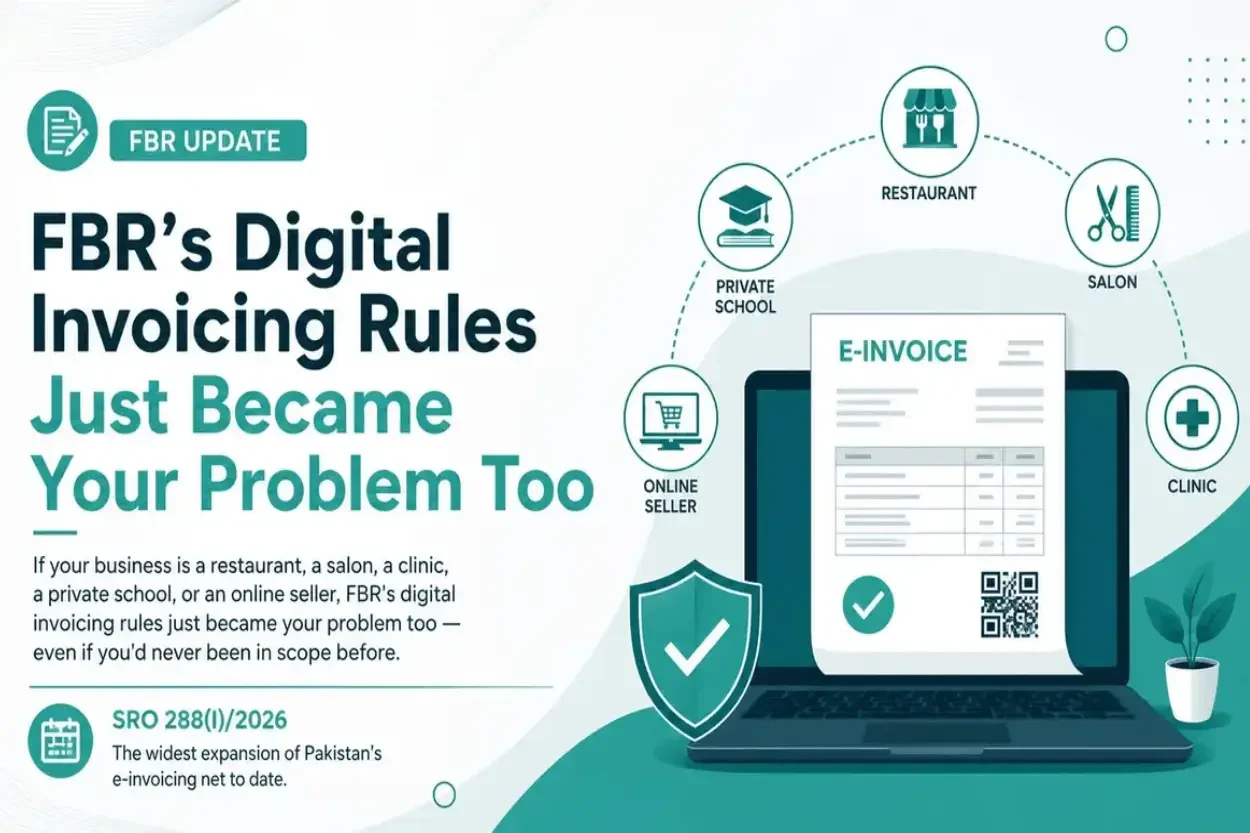
If your business is a restaurant, a salon, a clinic, a private school, or an online seller, FBR‘s digital invoicing rules just became your problem too — even if you’d never been in scope before. SRO 288(I)/2026 is the widest expansion of Pakistan’s e-invoicing net to date, and it reaches well beyond the retailers, wholesalers, and manufacturers who’ve been dealing with FBR digital invoicing until now.
This guide breaks down what SRO 288(I)/2026 actually introduces, which businesses it affects, the new requirements you need to know about — including a CCTV mandate that’s a first for Pakistan — and what to do if your business is on the notified list.
What Is SRO 288(I)/2026?
SRO 288(I)/2026, issued by the Federal Board of Revenue on February 18, 2026, is a notification under the Income Tax Ordinance, 2001 that introduces a new chapter called “Online Integration of Businesses,” replacing the earlier Chapter VIIA of the Income Tax Rules, 2002.
The key distinction to understand: earlier digital invoicing rules (like SRO 709 and SRO 1852) were issued under sales tax law and applied mainly to sales-tax-registered businesses. SRO 288(I)/2026 is different — it operates under income tax law, which is why it’s able to pull in service businesses and professionals who were never required to integrate before, regardless of their sales tax status.
As of this writing, elements of the framework are still being finalized, and FBR has continued issuing follow-up notifications and general orders to clarify implementation. If your business appears on the notified list, it’s worth confirming the current, finalized requirements directly with FBR or a licensed integrator rather than relying on the initial announcement alone — this is a fast-moving area of regulation.
Who Does SRO 288(I)/2026 Apply To?
This is the part that catches most business owners off guard. The notified categories go well beyond traditional retail and include:
- Hospitality: restaurants, hotels, guest houses, hostels, motels, marriage halls, and marquees
- Clubs: including members’ clubs and race clubs
- Transport and logistics: inter-city road transport operators, courier services, and cargo operators
- Health and beauty: beauty parlours, slimming centres, private clinics, dental clinics, hair transplant clinics, and hospitals
- Education: private schools, colleges, universities, and vocational training institutes
- Professional services: accountants, photographers, videographers, and event managers
- Financial services: foreign exchange dealers and exchange companies
- Retail: retailers of all kinds, including manufacturer-cum-retailers, wholesaler-cum-retailers, and importer-cum-retailers
- E-commerce: online sellers and online marketplaces
If your business falls into any of these categories, you’ll likely need to register your outlets, points of sale, and — for online sellers — your website or app, directly with FBR’s system.
What SRO 288(I)/2026 Actually Requires
Mandatory online registration and integration. Notified businesses must provide FBR with information about their outlets, points of sale, and electronic invoicing transactions through the Board’s online system. Once integrated, no supply can legally be made except through an integrated outlet, POS system, or electronic invoice-issuing machine.
Detailed, structured invoices. Invoices from integrated businesses need to carry significantly more information than a typical receipt — reportedly up to 26 mandatory fields, including seller and buyer details, tax amounts, HS codes (where applicable), and a digital signature, along with a unique FBR invoice number generated before the sale is even completed.
CCTV at points of sale. This is the headline change, and it’s a first for Pakistan’s tax enforcement. FBR can require notified businesses to install CCTV recording at each point of sale, with footage retained for at least one month and made available to the Commissioner of Inland Revenue on request. The purpose is straightforward: letting FBR cross-check physical sales activity against what’s actually being reported through the invoicing system.
Online seller registration. Businesses selling through websites or mobile apps must register those platforms with FBR so that transactions can be reported automatically as electronic invoices — a meaningfully different requirement from brick-and-mortar POS integration.
Signage requirements. Every integrated outlet must display an “Integrated with FBR” signboard bearing the official FBR logo — a visible, physical compliance marker in addition to the technical integration itself.
Offline handling and record retention. If your systems or internet connection go down, offline invoices must be uploaded within 24 hours of service being restored. All electronic records must be retained for six years, a considerably longer window than most businesses are used to for day-to-day sales data.
New Rules for Integrators Themselves
SRO 288(I)/2026 doesn’t just tighten requirements for businesses — it tightens who’s allowed to provide POS integration services in the first place. Under the new rules, a company can’t offer POS integration services without holding an FBR license, and qualifying for that license isn’t trivial: it reportedly requires at least Rs. 10 million in paid-up capital, registration with a recognized body such as the Pakistan Software Houses Association or ICAP, and three years of audited accounts. Licenses are valid for five years and are non-transferable.
PRAL (Pakistan Revenue Automation Limited) is set to operate as a licensed integrator in its own right, offering free integration services to taxpayers on request.
Practically, this means the FBR-integrator market itself is being formalized — if you’re evaluating integration partners, it’s worth confirming they hold (or are positioned to hold) the required license under this framework, not just a general claim of “FBR compliance.”
Penalties for Non-Compliance
FBR has indicated that businesses found tampering with the integration system, making sales through non-integrated channels, or otherwise violating the notified requirements will face penalties. Given how enforcement has played out under earlier SROs — tens of thousands of businesses integrated and billions of rupees in penalties already issued under SRO 1852 alone — there’s little reason to expect a lighter touch here, especially since CCTV and signage requirements make non-compliance much easier for FBR to spot.
How to Prepare If Your Business Is on the List
- Check whether your business category is notified. The list is broad and includes several service and professional categories that have never had to think about POS or e-invoicing integration before.
- Confirm your finalized requirements. Because this framework has been evolving through follow-up notifications, verify exactly what applies to your category and timeline before making infrastructure decisions.
- Choose a properly licensed integrator. With integrator licensing now formalized under SRO 288, work with a provider that meets — or is positioned to meet — the new licensing standard.
- Plan for the physical requirements, not just the software. CCTV installation, signage, and outlet-level registration are physical, on-premises requirements alongside the technical integration — budget and timeline for both.
- Build in record retention from day one. Six years is a long retention window; it’s easier to structure your data storage correctly from the start than to retrofit it later.
How NatureTech Helps
NatureTech is an FBR Official Licensed Integrator, and we’re tracking SRO 288(I)/2026 closely as it moves toward final implementation. If your business is in a newly notified category — a school, a clinic, a salon, an online store, or anywhere else on the list — we can help you understand exactly what applies to you and get your integration in place before enforcement catches up with the notification.
This article reflects SRO 288(I)/2026 as understood at the time of writing. Because this framework has been updated through subsequent FBR notifications and general orders, always confirm your business’s current, finalized obligations directly with FBR or a licensed integrator before making compliance decisions.