Understanding the FBR Licensed Integrator Status: Why It Matters for Your Business
Pakistan’s tax and invoicing environment is rapidly moving toward real-time digital reporting. For businesses required to comply with the Federal Board of Revenue’s (FBR) electronic invoicing framework, simply having accounting or billing software is no longer enough.
The connection between your ERP, POS, or invoicing system and FBR’s computerized system needs to follow the prescribed integration process. This is where an FBR Licensed Integrator becomes important.
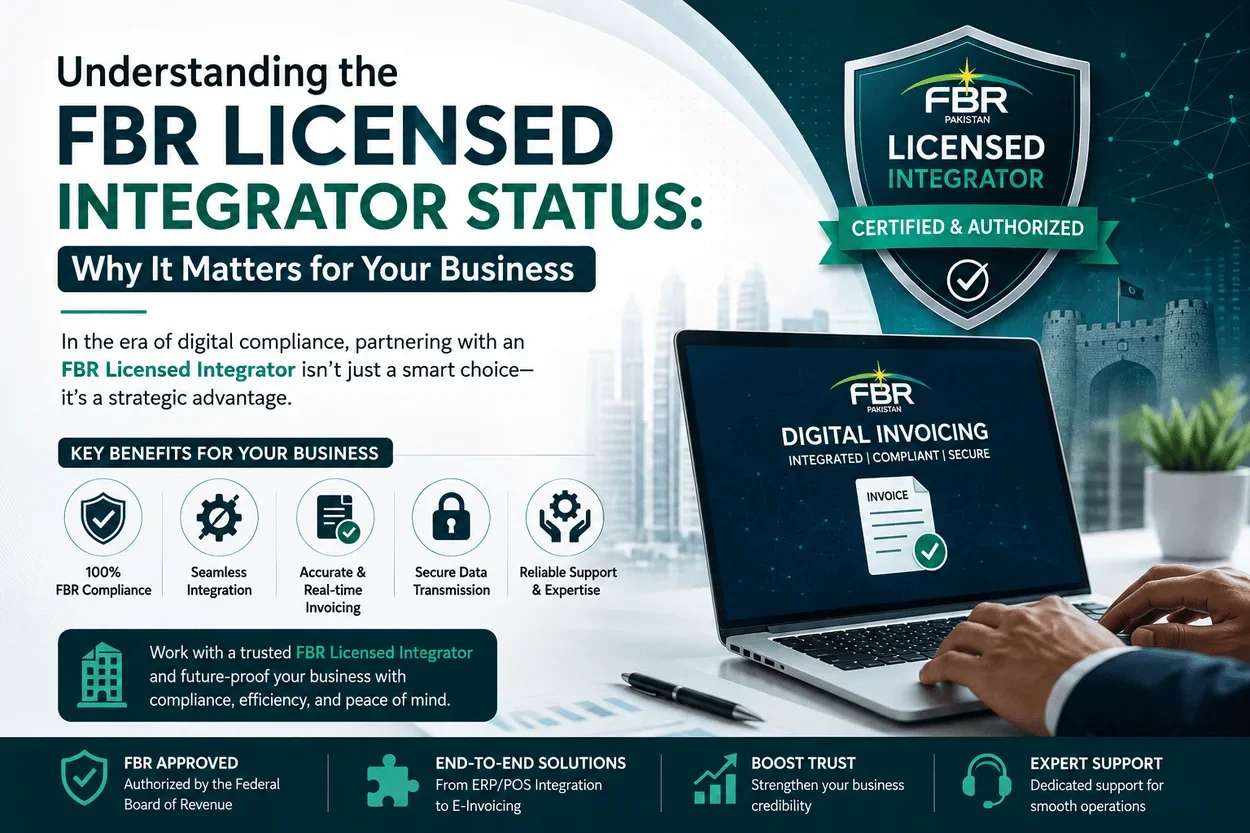
According to FBR, a licensed integrator is a person or entity licensed by the Board to provide an electronic invoicing system for integrating registered persons with FBR in the prescribed manner. FBR also states that notified registered persons must integrate their POS, ERP, or other invoicing systems through a licensed integrator holding a valid FBR integration license.
For businesses, this means that choosing the right integration partner is not simply a technology decision—it is also an important compliance and operational decision.
What Is an FBR Licensed Integrator?
An FBR Licensed Integrator is an entity authorized by the Federal Board of Revenue to facilitate the integration of a registered business’s electronic invoicing system with FBR.
In simple terms, the integrator acts as the technical bridge between your existing business software and FBR’s digital invoicing infrastructure.
Your business may already use:
- ERP software
- POS software
- Accounting software
- Retail billing systems
- Manufacturing software
- Distribution management systems
- Customized invoicing applications
Instead of replacing these systems, a licensed integrator can help connect the relevant invoicing workflow to FBR according to the applicable technical and regulatory requirements.
FBR specifically states that only a licensed integrator with a valid FBR license can configure a registered person’s electronic invoicing software for real-time electronic transmission of sales tax invoices to FBR’s server.
Why Did FBR Introduce Licensed Integrators?
Digital invoicing requires more than simply converting a paper invoice into a PDF.
An electronic invoice needs to be generated in the prescribed structure and transmitted electronically. The system must also handle data validation, connectivity, responses, and other technical requirements.
The legal framework for electronic invoicing has evolved through amendments to the Sales Tax Act and related rules. FBR’s explanatory material defines a licensed integrator and provides for integration of electronic invoicing systems with the Board’s computerized system for real-time reporting.
Licensed integrators therefore help businesses implement the technical side of this regulatory requirement.
Why FBR Licensed Integrator Status Matters
1. It Helps Establish Regulatory Alignment
One of the biggest advantages of working with an officially licensed integrator is that the business can work with a provider that has been authorized under the applicable FBR framework.
FBR maintains an official list of licensed integrators, including license numbers, NTN information, business names, contact details, and downloadable license certificates.
Before selecting a provider, businesses should verify that the provider appears on the current FBR list.
Note: Do not rely only on marketing claims such as “FBR compatible” or “FBR integrated.” Verify the provider’s current licensing status.
2. Your Existing ERP or POS Can Be Integrated
Businesses often worry that FBR Digital Invoicing means they must replace their existing ERP or POS.
That is not necessarily the case.
FBR allows notified registered persons to use commercial electronic invoicing software and integrate it with FBR through a licensed integrator.
A professional integration project can therefore connect systems such as:
ERP → Integration Layer → FBR
or
POS → Integration Layer → FBR
This approach allows businesses to preserve their existing operational workflows while adding the required digital reporting capability.
3. Real-Time Invoice Transmission Becomes Part of the Workflow
Traditional invoicing often involves creating an invoice first and handling tax reporting later.
Digital invoicing changes that workflow.
A compliant integration can automate the process:
Invoice Created → Data Validation → FBR Submission → FBR Response → Invoice/Record Updated
This can significantly reduce manual intervention.
It also helps businesses create a more consistent connection between their:
- Sales records
- Tax information
- ERP/POS transactions
- Digital invoices
- FBR reporting
4. It Reduces Manual Data Entry
Manual data entry creates opportunities for mistakes.
For example, an invoice may contain:
- Incorrect tax rates
- Incorrect buyer information
- Wrong product codes
- Incorrect quantities
- Incorrect taxable values
- Data mismatches between ERP and invoice
With an integrated system, relevant information can be transferred automatically from the business application to the digital invoicing workflow.
This can reduce repetitive work and improve data consistency.
FBR Licensed Integrator vs Ordinary Software Vendor
Not every software company that offers invoicing software is necessarily an FBR Licensed Integrator.
This distinction is important.
| Feature | Ordinary Software Vendor | FBR Licensed Integrator |
|---|---|---|
| Provides billing software | Usually | Yes |
| ERP/POS integration | May offer | Yes |
| FBR integration capability | May vary | Within licensed framework |
| FBR license verification | Not applicable | Can be verified through FBR |
| Technical integration support | Varies | Core integration service |
| Compliance-focused implementation | Varies | Yes |
| Real-time FBR integration | Depends on solution | Designed for this purpose |
The key point is simple:
Software compatibility is not the same as FBR licensed integration.
How to Verify an FBR Licensed Integrator
Before signing an agreement with an integration provider, businesses should perform a basic verification process.
Step 1: Visit the FBR Licensed Integrator List
FBR maintains a list of licensed integrators on its official website.
View FBR’s Official List of Licensed Integrators
Step 2: Check the Business Name
Confirm that the provider’s legal/business name appears on the list.
Step 3: Check the License Number
Ask the provider for its FBR digital invoicing license certificate and compare the details with FBR’s published information.
Step 4: Check the License Validity
Licenses have issuance and expiry information. Always confirm that the license is currently valid.
Step 5: Evaluate Technical Capability
Licensing is important, but it is only one part of choosing an integration partner.
You should also evaluate whether the provider can handle:
- ERP integration
- POS integration
- API connectivity
- Data mapping
- Testing
- Error handling
- Multiple branches
- High invoice volumes
- Backup and recovery
- Ongoing technical support
How FBR Digital Invoicing Works
What Should a Good FBR Integration Solution Include?
A strong digital invoicing solution should go beyond simply connecting an API.
Businesses should look for a solution that provides:
Automated Invoice Submission
Invoices should move from the business system into the FBR reporting workflow with minimal manual intervention.
Data Validation
The solution should identify missing or incorrect information before submission wherever technically possible.
ERP Integration
Manufacturers, distributors, wholesalers, and larger organizations often require integration with their ERP.
POS Integration
Retailers and businesses operating multiple points of sale may require centralized POS integration.
Error Management
Rejected or unsuccessful transactions should be clearly identified so the responsible team can investigate and resolve them.
Reporting and Audit Trails
Businesses should be able to track invoice activity and maintain appropriate records for internal reconciliation and compliance.
Regulatory Updates
Digital tax requirements and technical specifications can change. A good integration partner should have a process for monitoring relevant FBR updates and maintaining its solution accordingly.
Why Businesses Should Not Choose an Integrator Based Only on Price
Cost is naturally an important consideration, but choosing the cheapest provider may create problems later.
An integration provider should be evaluated based on total value, including:
- Licensing status
- Technical expertise
- ERP/POS experience
- Implementation methodology
- Support availability
- Security practices
- Scalability
- Error handling
- Regulatory update management
- Data protection
- Business continuity
A low-cost integration that repeatedly fails or requires extensive manual correction can ultimately cost much more than a properly implemented solution.
PRAL and Private Licensed Integrators
Businesses should also understand that FBR’s framework provides an important option involving PRAL.
FBR states that, under the relevant rules, PRAL acts as a licensed integrator for specified purposes and can provide integration services free of cost to registered persons on demand.
Private licensed integrators can offer businesses additional implementation and technical support options depending on their requirements.
The right choice depends on factors such as:
- Business size
- Number of branches
- Invoice volume
- ERP/POS complexity
- Internal IT resources
- Required customization
- Support requirements
What Businesses Should Ask Before Choosing an Integrator
Before selecting an FBR integration partner, ask these questions:
- Are you currently listed as an FBR Licensed Integrator?
Request the license details and verify them independently. - Can you integrate with our existing ERP?
Replacing an ERP simply for digital invoicing may not be necessary. - Can you integrate our POS?
This is particularly important for retail, restaurants, hospitality, and multi-branch businesses. - How will rejected invoices be handled?
A good implementation should have a clear error-resolution process. - How will regulatory updates be handled?
Ask who is responsible when FBR changes technical requirements. - Do you provide testing before production?
Testing should be an important part of deployment. - What support is included?
Understand response times, escalation procedures, maintenance, and support availability. - How is business data protected?
Invoice information can contain commercially sensitive information. Security and access controls should therefore be considered during vendor selection.
NatureTech as an FBR Licensed Integrator
NatureTech is listed by FBR among its licensed integrators for digital invoicing. FBR’s current published list identifies NATURETECH (PRIVATE) LIMITED with license number 555378169.
NatureTech provides digital invoicing integration services designed to connect business systems with FBR, including ERP and POS integration.
Its digital invoicing offering focuses on helping businesses move from manual invoicing toward automated, technology-driven compliance workflows.
For businesses evaluating an integration partner, the important distinction is that NatureTech’s status can be independently checked against FBR’s official licensed-integrator list.
Explore NatureTech’s FBR Digital Invoicing Integration
Benefits of Working With the Right FBR Integrator
Choosing the right partner can provide several practical advantages.
Better Compliance Management
Your invoicing workflow is designed around the applicable FBR integration requirements.
Reduced Manual Work
Automated data transfer can reduce repetitive invoice submission activities.
Better Accuracy
Automated mapping and validation can help reduce data-entry mistakes.
ERP/POS Connectivity
Your existing business software can potentially remain at the center of your operations.
Faster Issue Resolution
A dedicated technical partner can help troubleshoot integration problems.
Scalability
The integration architecture can be designed to support business growth, additional branches, and increased invoice volumes.
Future Readiness
Businesses can establish a technology foundation that can adapt as Pakistan’s digital tax ecosystem continues to evolve.
FBR Licensed Integrator: A Compliance Decision, Not Just an IT Decision
The importance of an FBR Licensed Integrator goes beyond connecting two systems.
Your invoicing system is closely connected to:
Sales → Tax Calculation → Invoice Generation → Digital Submission → FBR Response → Accounting → Reporting
A failure anywhere in this chain can create operational and compliance challenges.
That is why businesses should treat the selection of an FBR integration partner as a strategic decision involving finance, tax, IT, operations, and management.
Final Thoughts
FBR Digital Invoicing is changing the way businesses in Pakistan generate, transmit, and manage sales invoices.
For notified businesses, integration is not simply about purchasing new software. It is about establishing a reliable connection between the organization’s existing invoicing environment and FBR’s digital infrastructure.
An FBR Licensed Integrator provides an important part of that process.
Before choosing a provider, verify its license directly through FBR, understand its technical capabilities, assess its ERP/POS integration experience, and make sure you have a clear plan for testing, support, security, and future regulatory changes.
FBR itself maintains the official list of licensed integrators and states that notified registered persons can integrate their POS, ERP, or other invoicing systems through a licensed integrator with a valid FBR integration license.
The right integration partner can turn FBR Digital Invoicing from a compliance challenge into an automated and efficient part of your business operations.
FAQ’s
What is an FBR Licensed Integrator?
An FBR Licensed Integrator is an entity licensed by FBR to provide electronic invoicing integration services for registered persons in the prescribed manner.
Is an FBR Licensed Integrator mandatory?
For notified registered persons, FBR states that POS, ERP, or other invoicing systems must be integrated through a licensed integrator with a valid FBR integration license, subject to the applicable rules and provisions.
Can I keep my existing ERP?
Yes. Businesses can use commercial electronic invoicing software and integrate it with FBR through a licensed integrator. Whether your particular ERP can be integrated depends on its technical architecture and the integration solution.
How can I verify a licensed integrator?
Check the provider against FBR’s official List of License Integrators and verify the business and license details.
Does FBR charge a fee for integration?
FBR states that a registered person or licensed integrator is not liable to pay a fee to FBR for this purpose, while the licensed integrator may charge the business for configuration and integration services subject to the applicable limits specified by FBR.
Is physical attendance at an FBR office required?
FBR states that a physical visit is not required for integration and that technical resources and help material are available through its website.
Is PRAL an FBR Licensed Integrator?
Yes — per the original content above, FBR states that PRAL acts as a licensed integrator for specified purposes under the relevant rules and can provide integration services free of cost to registered persons on demand.
What is the difference between ERP integration and POS integration under FBR’s framework?
ERP integration generally applies to businesses running enterprise resource planning systems (common for manufacturers, distributors, and wholesalers), while POS integration applies to retail, restaurant, and multi-branch point-of-sale environments. Both are described in the original content as capabilities a licensed integrator should be evaluated on.
What happens if an integrator’s license expires?
The original content advises businesses to always confirm that a provider’s license is currently valid before signing an agreement — this is listed as one of the core verification steps.
Related Article
Getting Started with FBR Digital Invoicing
ERP vs POS Integration for FBR Compliance