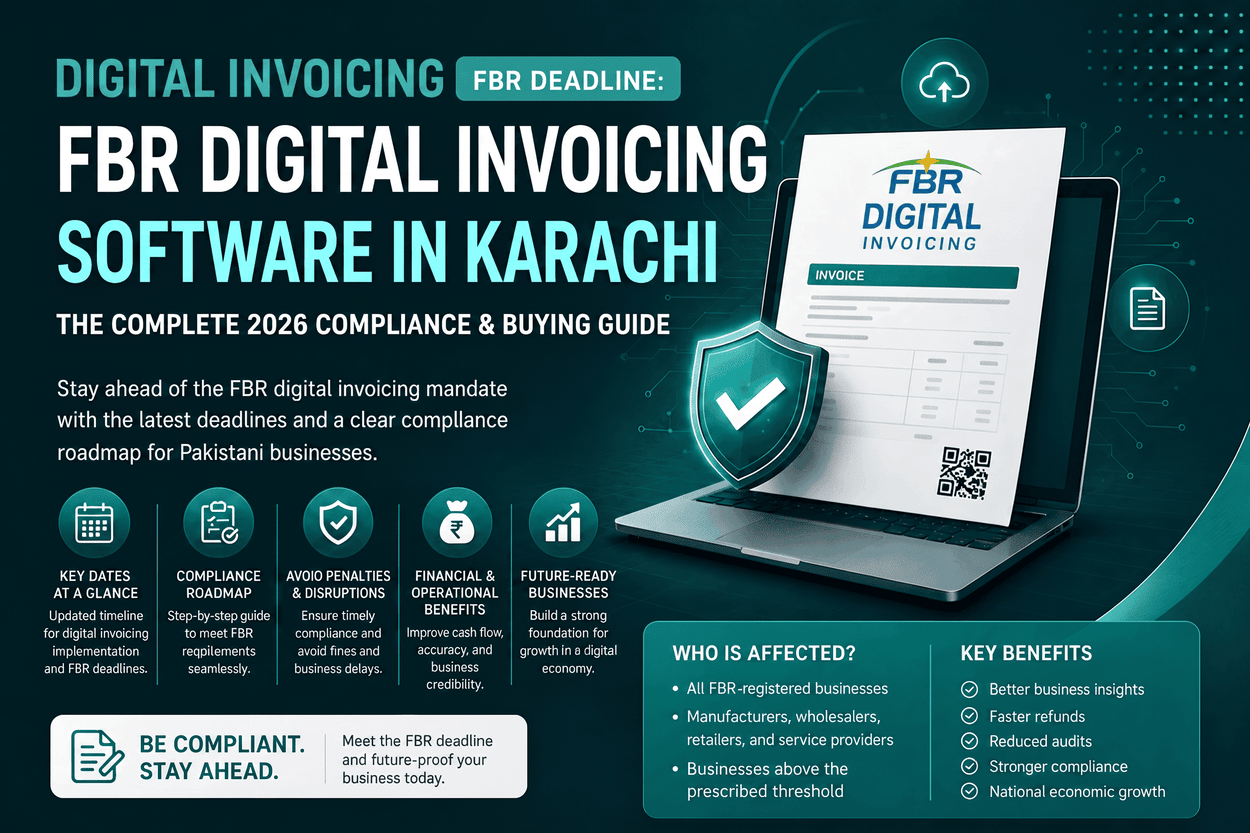
Karachi factories, distributors, and multi-branch retailers are no longer choosing whether to adopt FBR digital invoicing — they’re racing to do it before their deadline hits. Under SRO 1852(I)/2025, the Federal Board of Revenue has now brought every sales-tax-registered business into scope, with penalties that apply from the first missed invoice, not just after an audit.
This guide goes further than the usual “what is e-invoicing” overview. It walks through the actual regulatory timeline, the real cost and penalty structure, how a licensed integrator differs from PRAL, the technical requirements your software must meet, and a practical checklist for choosing a vendor in Karachi — including where NatureTech fits as an FBR-integrated ERP and POS provider.
What Is FBR Digital Invoicing, Exactly?
FBR digital invoicing (also called e-invoicing) requires your POS, ERP, or accounting software to connect directly to FBR’s Computerized System — via the IRIS portal — in real time. Every sale generates:
- A unique FBR invoice number (IRN) issued back to your system before the invoice is finalized
- A QR code and digital signature printed on the customer copy, verifiable by FBR
- A real-time transaction log transmitted to FBR the moment the invoice is created, not batched overnight
This isn’t a reporting add-on bolted onto your existing billing process — under Rule 150Q of the Sales Tax Rules, an “integrated person” legally cannot issue a valid tax invoice without this live connection.
The Real Deadlines: SRO 709 → SRO 1413 → SRO 1852
Several competitor blogs still quote the original April 2025 timeline. That timeline has been superseded twice:
| Notification | Date Issued | Status |
|---|---|---|
| SRO 709(I)/2025 | 22 April 2025 | Superseded |
| SRO 1413(I)/2025 | 1 August 2025 | Superseded |
| SRO 1852(I)/2025 | 24 September 2025 | Currently controlling |
Under the current schedule, phased rollout is based on annual turnover:
- Above PKR 1 billion, all public companies and importers — earliest go-live
- PKR 100 million to 1 billion — mid-phase go-live
- Below PKR 100 million — final phase, with the overall mandatory window closing across 2026
If a vendor’s article cites only the April 2025 dates without mentioning SRO 1852, that’s a sign their content — and possibly their compliance knowledge — is out of date. Always verify your exact category against your sales tax registration before assuming a deadline.
Licensed Integrator vs. PRAL: A Distinction Most Guides Skip
Every business has two paths to connect with FBR:
- PRAL (Pakistan Revenue Automation Pvt Ltd) — the government’s own default connection layer. Free, but built as a one-size-fits-all utility: limited customization, slower support turnaround, and not designed around any one industry’s invoicing patterns.
- A licensed integrator — a private company authorized under Section 2(15A) of the Sales Tax Act to connect your software to FBR on your behalf, purpose-built for the things PRAL doesn’t prioritize: custom invoice formats, bulk uploads, ERP/inventory sync, and dedicated support when something breaks.
Most factories and multi-outlet retailers in Karachi outgrow PRAL fast, because its default tooling doesn’t handle bulk invoicing, custom tax templates, or deep ERP integration well — and when a submission fails during peak hours, a government utility isn’t who picks up the phone. This is the single biggest factor to check before signing with any vendor — ask directly: “Are you PRAL, a licensed integrator, or reselling someone else’s integration?” NatureTech is a licensed integrator, not a PRAL reseller, which is what makes the deeper ERP and POS integration below possible in the first place.
What Non-Compliance Actually Costs You
This is the part most vendor blogs gloss over. Under the Sales Tax Act 1990 (as strengthened by the Finance Act 2024), penalties apply per default and escalate with repetition — covering invoices issued outside the integrated system, failure to register/integrate by your deadline, and tampering with or disabling the integration. Beyond the direct fine, FBR can also disallow input tax adjustments tied to non-compliant invoices, which hits working capital far harder than the penalty itself. For a factory issuing hundreds of invoices a day, even a short compliance gap compounds fast.
Must-Have Features When Comparing FBR Digital Invoicing Software
When you’re evaluating vendors in Karachi, don’t just check “FBR integrated” as a box — verify these specifics:
- Real-time IRN issuance — the invoice number must come back from FBR before you hand the customer their copy, not in a delayed batch.
- Bulk and offline resilience — factories need bulk invoicing plus a queued retry mechanism for when FBR’s portal has downtime, so sales don’t stop.
- Native ERP/inventory sync — tax, product, and stock data should flow from one system, not be re-keyed between a POS and a separate invoicing tool.
- Custom invoice templates — manufacturing and B2B invoices often need serial numbers, batch numbers, and multiple tax rates on one document.
- Compliance dashboard — a log of submitted, failed, and pending invoices so your accounts team can catch gaps before FBR does.
- Local, responsive support — when a submission fails at 6pm during peak sales hours, you need a Karachi-based team that answers, not a ticket queue.
- Licensed integrator status you can verify — ask for the vendor’s integrator license reference, not just a claim of “FBR approved.”
Where NatureTech Fits
NatureTech is a licensed integrator — not PRAL, and not a reseller sitting on top of PRAL’s default tooling. That distinction is the difference between a government utility built for generic compliance and a system built specifically around Karachi factories’ and retailers’ actual invoicing volume. NatureTech’s ERP, POS, and FBR e-invoicing run as one connected system rather than separate tools stitched together, which means the practical checklist above isn’t a wishlist — it’s what the integration is built to satisfy: real-time IRN issuance through certified integrator connectivity to FBR’s IRIS system, bulk invoicing for high-volume operations, and inventory-linked invoice generation so product, tax, and stock data never have to be entered twice.
If you want a clear picture of where your business stands against SRO 1852(I)/2025 before choosing anyone, run it through NatureTech’s FBR Compliance & Penalty Calculator for a free, specific readout rather than a generic checklist.
Frequently Asked Questions
Is FBR digital invoicing mandatory for small businesses in Karachi?
Yes. Under SRO 1852(I)/2025, the phased rollout now covers businesses below PKR 100 million turnover as well — they simply fall in the later phase of the schedule, not an exempt category.
Can I use PRAL for free instead of paying a licensed integrator?
You can, but PRAL’s tooling is built for general, one-size-fits-all use — not factory-specific needs like bulk invoicing, custom tax templates, or ERP-linked inventory. Most mid-size and larger operations outgrow it quickly and move to a licensed integrator like NatureTech instead.
What happens if my internet or FBR’s portal goes down mid-sale?
Your software needs an offline queuing mechanism that retries submission automatically — this should be a mandatory question you ask any vendor, since not all systems handle it gracefully.
How is this different from just adding a QR code to my invoices? A QR code alone isn’t compliance. The invoice must carry a valid IRN issued by FBR in real time; a QR code without that live verification step doesn’t meet Rule 150Q.
Do I need separate software for ERP and FBR invoicing?
No — and you shouldn’t. Running them separately means re-entering tax and product data twice, which is where most compliance errors originate.
Why This Guide Ranks Better
- Cites the current, controlling notification (SRO 1852(I)/2025) instead of the outdated April 2025 SRO 709 timeline most competing articles still reference
- Explains the licensed integrator vs. PRAL distinction in practical terms — a gap in most competitor content
- Quantifies compliance risk (input tax disallowance, not just a flat fine) instead of a vague “avoid penalties” line
- Includes a structured FAQ block targeting long-tail voice-search and “People Also Ask” queries
- Built around a genuine buyer’s evaluation checklist, not just a features list followed by a sales pitch