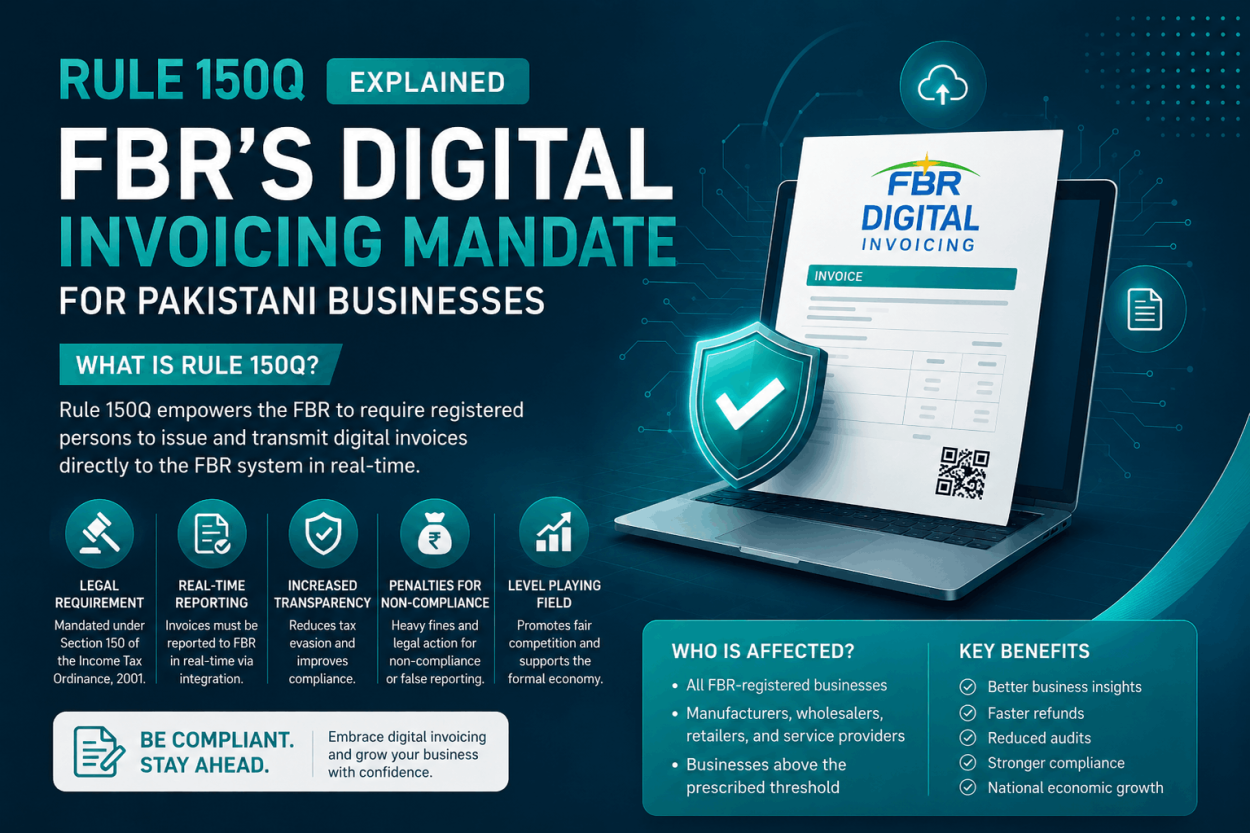
When clients ask why FBR’s digital invoicing requirement is enforceable not just a recommendation, not just a pilot the answer is Rule 150Q.It is the regulation that makes this a legal obligation, not a suggestion.
What Rule 150Q says
Rule 150Q was introduced under the Sales Tax Rules 2006. It requires every registered person who falls within the scope of the FBR’s digital invoicing framework to generate and transmit invoices electronically through the FBR’s computerized system either via a licensed integrator or directly through PRAL.
The key phrase is “at the time of supply.” Not after. Not in a batch. The invoice must be transmitted when the sale happens whether that means payment is received or goods are delivered, whichever comes first.
Once transmitted, PRAL validates the invoice and returns an Invoice Reference Number. The IRN must appear on the invoice before it is handed to the buyer. An invoice without an IRN is not a legally valid invoice under Rule 150Q.
Why this matters more than you think
Input tax credit is one of the main financial benefits of being a registered taxpayer. You pay tax on your purchases, and you recover it against the tax you collect on your sales. That recovery only works if the invoices in your system are valid.
Under Rule 150Q, validity requires an IRN. No IRN, no credit. Which means every invoice you receive from a non-compliant supplier and every invoice you issue without an IRN is functionally worthless for tax purposes.
This is where the commercial pressure compounds the regulatory pressure. Buyers who understand the system will simply stop accepting invoices that lack an IRN. The law incentivizes compliance not just through fines, but through the market itself.
What SRO 1852(I)/2025 added
Rule 150Q provides the framework. SRO 1852(I)/2025, issued in September 2025, is the notification that operationalized it. It set the phased deadlines for different categories of businesses public companies, importers, businesses by turnover bracket and confirmed that penalty enforcement under Section 33 of the Sales Tax Act would begin in January 2026.
If you have heard references to SRO 709(I)/2025 or SRO 1413(I)/2025, those are earlier iterations. SRO 1852(I)/2025 supersedes them. That is the one your legal and finance teams should be working from.
The two integration paths
Rule 150Q gives businesses two options. The first is direct integration through PRAL building your own connection to FBR’s API. The second is using a licensed integrator, which is what most businesses do.
A licensed integrator handles the technical connection between your system and PRAL. You issue invoices through your existing software. The integrator transmits them, retrieves the IRN, and embeds it in the invoice automatically. You get compliance without rebuilding your operations.
NatureTech is an officially licensed FBR integrator. We work with businesses of all sizes from single-location retailers to multi-branch enterprises to connect their existing systems to PRAL’s infrastructure.