What Is STGO 01 of 2026?
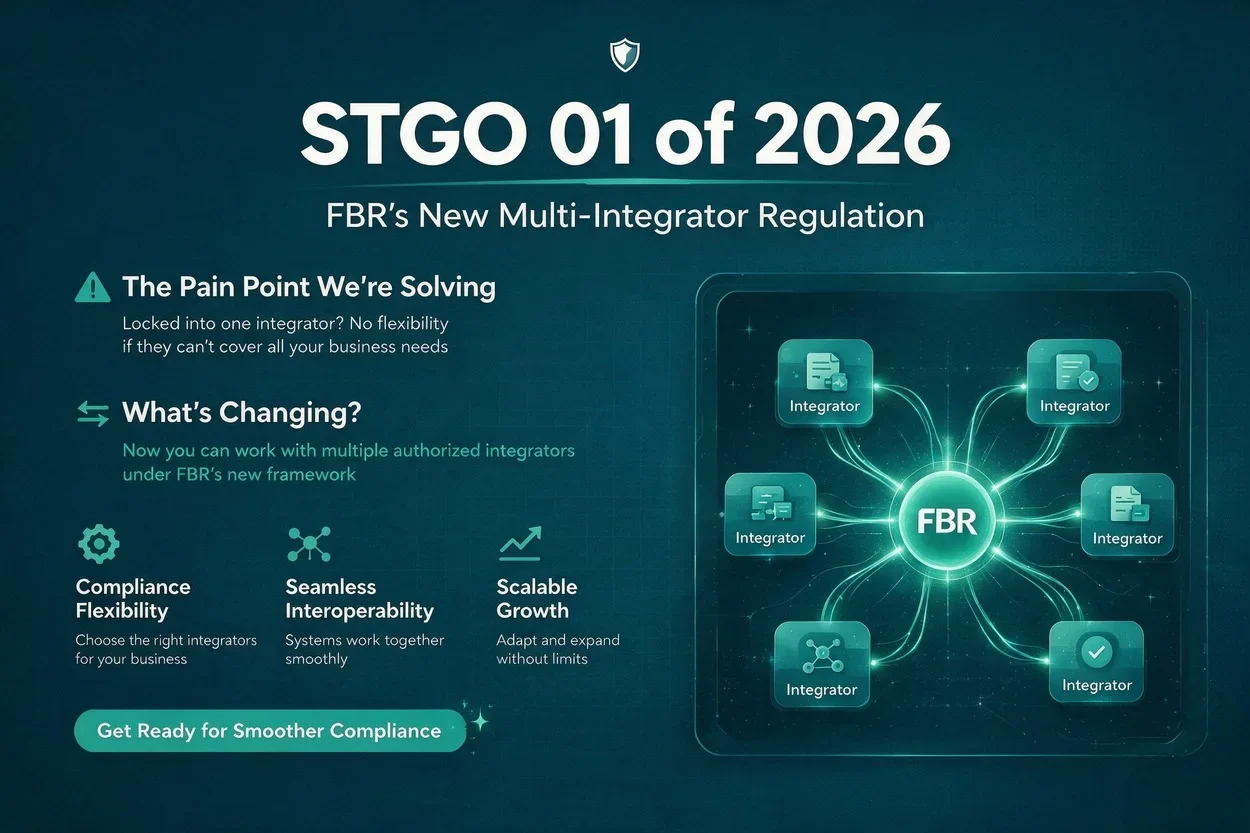
If you’ve been managing FBR digital invoicing compliance since last year, you’ve probably run into at least one frustrating limitation: being locked into a single licensed integrator, with no easy way to bring in a second vendor if your first choice couldn’t cover every part of your business.
In early 2026, FBR addressed exactly this problem.
This guide breaks down what Sales Tax General Order (STGO) No. 01 of 2026 actually changed, why it matters, and what your business should do about it.
STGO 01 of 2026 is a Sales Tax General Order issued by the Federal Board of Revenue in early 2026, under the title “Issuance of Electronic Sales Tax Invoices and Integration of Registered Persons.”
It doesn’t introduce a new tax obligation — instead, it clarifies and adjusts how the existing digital invoicing mandate (originally created through SRO 1413(I)/2025) actually works in practice.
FBR issued this clarification after receiving feedback from businesses that had run into real operational difficulty relying on a single integrator for their entire invoicing setup — particularly companies with multiple business lines, multiple systems, or complex operational structures where one integrator’s technical scope simply didn’t fit.
Useful links
Change #1: You Can Now Use More Than One Licensed Integrator
This is the headline change.
Under the original framework, registered persons were expected to integrate their invoicing hardware and software with FBR’s system through a single licensed integrator.
STGO 01 of 2026 removes that restriction.
Businesses can now engage one or more FBR-licensed integrators for their electronic invoicing integration — as approved or notified by the Board, wherever required.
In practice, this means:
- A business with separate POS and ERP systems can use a different integrator for each, instead of forcing everything through one vendor.
- A business with multiple branches, subsidiaries, or product lines can split integration work across integrators that specialize in different areas.
- If one integrator’s service quality drops, or their technical capability doesn’t extend to a new part of your business, you’re no longer stuck — you can bring on a second, without abandoning the first.
The order frames this as giving businesses flexibility in system architecture and vendor selection while keeping invoice reporting centralized to FBR — so from a compliance standpoint, nothing about what gets reported changes, only who you can use to get it there.
Useful links
Change #2: A Strict 72-Hour Window for Invoice Corrections
The second part of STGO 01 of 2026 is less talked about but arguably more operationally significant.
Once an electronic sales tax invoice is issued, it can now only be cancelled, deleted, or edited — for a genuine, bona fide mistake — within 72 hours of its original generation, and only directly through FBR’s system.
If you need to correct an invoice after that 72-hour window has passed, you can no longer just fix it yourself.
You’ll need prior approval from the Commissioner Inland Revenue, subject to whatever conditions the Board specifies.
This is a meaningful shift in day-to-day operations.
It means:
- Your billing team needs a process for catching invoicing errors fast — ideally same-day, not “we’ll fix it next week.”
- Any manual review or reconciliation step that used to happen monthly now needs to happen closer to real time.
- Businesses relying on end-of-month invoice cleanup will need to rebuild that workflow around the 72-hour ceiling.
Why This Matters for Your Business Right Now
If you integrated early in 2025 or 2026 under the original single-integrator model, it’s worth revisiting your setup with these two changes in mind:
1. Are you outgrowing your current integrator?
If your business has expanded, added new POS locations, or brought in a new ERP module that your current integrator can’t cleanly support, you no longer need to switch entirely — you can add a second integrator instead.
2. Does your invoicing workflow have a fast-correction process?
If errors currently get caught and fixed weeks after the fact, that process needs to be rebuilt around the 72-hour rule, or you’ll be stuck requesting Commissioner approval for routine fixes.
A Note on Accuracy
Digital invoicing rules in Pakistan have moved quickly since 2025, with deadlines and clarifications issued in phases.
If you’re making compliance decisions based on any specific figure, deadline, or penalty amount, verify it against the current Sales Tax Act 1990 provisions and FBR’s official notifications, or speak with a licensed integrator or tax advisor directly — general guides (including this one) are a starting point, not a substitute for confirming your specific situation.
Official References
- Federal Board of Revenue (FBR): https://fbr.gov.pk
- Federal Board of Revenue SROs & Notifications: https://www.fbr.gov.pk/sros
- Sales Tax Act, 1990 (Official): https://www.fbr.gov.pk/categ/sales-tax-act/301
How NatureTech Can Help
As an FBR Official Licensed Integrator, NatureTech can help you evaluate whether a multi-integrator setup makes sense for your business, and make sure your invoicing workflow is built to catch and correct errors well inside the new 72-hour window — before they become a compliance problem.
Book a Free Demo to talk through your specific setup, or explore our Digital Invoicing solution to see how DigiTex handles real-time invoice submission and audit-ready compliance.
This article reflects FBR’s Sales Tax General Order No. 01 of 2026 as understood at time of publication.
Tax regulations are subject to change — confirm current requirements with FBR or a qualified tax advisor before making compliance decisions.
Supplemental Comparison Table
| Before STGO 01 of 2026 | After STGO 01 of 2026 |
|---|---|
| Single licensed integrator model | Multiple licensed integrators permitted (where approved or notified by the Board, wherever required) |
| Limited vendor flexibility | Greater flexibility for complex business environments |
| Integration changes often required complete vendor replacement | Additional licensed integrators can be engaged without necessarily replacing the existing one |
| Invoice correction practices varied operationally | 72-hour correction window established before Commissioner approval becomes necessary |
Implementation Checklist
Use this checklist to evaluate your current compliance process:
- Review your existing digital invoicing integration.
- Determine whether multiple licensed integrators would improve your operational setup.
- Review POS, ERP, and branch integration requirements.
- Confirm your invoice correction workflow operates within the 72-hour period.
- Train billing and finance teams on updated operational requirements.
- Periodically verify compliance against the latest FBR notifications.
Related links
- Complete Guide to FBR Digital Invoicing
- SRO 1413(I)/2025 Explained
- FBR Licensed Integrator Services
- DigiTex Digital Invoicing Platform
- ERP Integration Services
- POS Integration Guide
- Electronic Invoice Compliance Checklist
- Contact NatureTech
Recommended External References
- Federal Board of Revenue (FBR): https://fbr.gov.pk
- FBR Notifications & SRO Repository: https://www.fbr.gov.pk/ShowSROs?Department=Income%20Tax
- Sales Tax Act, 1990: https://www.fbr.gov.pk/categ/sales-tax-act/301
- Pakistan Revenue Automation (where applicable): https://pral.com.pk
Frequently Asked Questions (FAQ)
What is STGO 01 of 2026?
STGO 01 of 2026 is a Sales Tax General Order issued by the Federal Board of Revenue that clarifies operational requirements for electronic sales tax invoicing and registered person integration.
Does STGO 01 of 2026 introduce a new tax?
No. According to the article above, it clarifies and adjusts how the existing digital invoicing mandate operates in practice.
Can businesses now use more than one licensed integrator?
Yes. According to STGO 01 of 2026, businesses can engage one or more FBR-licensed integrators for electronic invoicing integration, as approved or notified by the Board, wherever required.
How long do businesses have to correct an electronic sales tax invoice?
The article explains that invoices may only be cancelled, deleted, or edited for a genuine, bona fide mistake within 72 hours of their original generation through FBR’s system.
What happens after the 72-hour correction period?
According to the article, prior approval from the Commissioner Inland Revenue is required, subject to whatever conditions the Board specifies.
Should businesses review their existing integration setup?
Yes. Businesses operating under the previous single-integrator model may benefit from evaluating whether a multi-integrator approach better suits their operational requirements.
Where can businesses verify the latest requirements?
Businesses should consult the Federal Board of Revenue (FBR), official notifications, the Sales Tax Act 1990, or a qualified tax advisor before making compliance decisions.