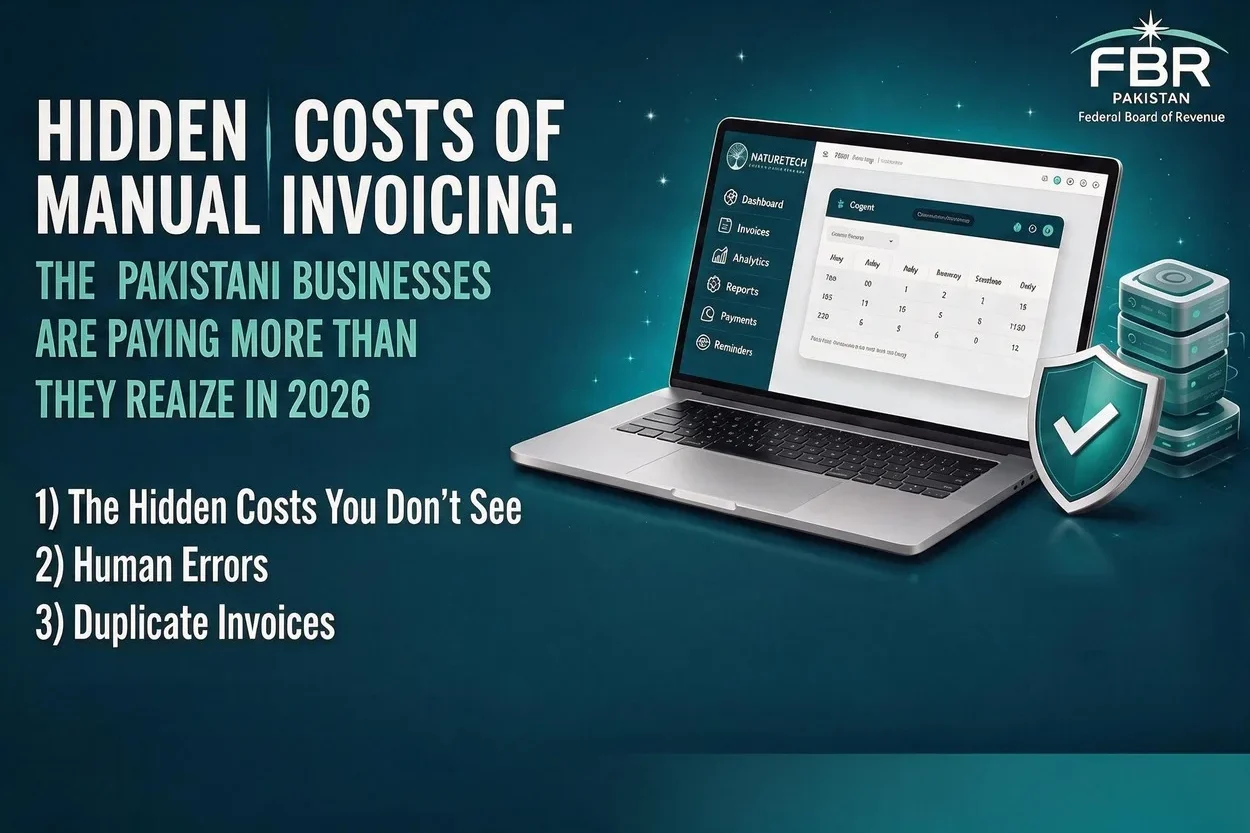
Hidden Costs of Manual Invoicing : Why Pakistani Businesses Are Paying More Than They Realize in 2026
Key Takeaways
- FBR’s e-invoicing regime — built on Section 50 of the Sales Tax Act, 1990 and Chapter XIV of the Sales Tax Rules, 2006 — is no longer a future requirement. Under SRO 69(I)/2025 and SRO 709(I)/2025, corporate registered persons were required to integrate by June 1, 2025, and non-corporate registered persons by July 1, 2025, with the phased rollout (SRO 1852(I)/2025) extending coverage to essentially all sales-tax-registered persons by the end of 2025.
- FBR began actively enforcing penalties for non-integration starting January 2026.
- Manual invoices issued outside the FBR Digital Invoicing (DI) system don’t carry a valid FBR invoice number or QR code — which means they may not support the buyer’s input tax adjustment, a problem that quietly damages B2B relationships.
- Tier-1 retailers who fail to integrate their POS systems face a specific, officially documented penalty of up to Rs. 1 million under clause 25 of the Table in Section 33 of the Sales Tax Act, plus a 15% reduction in adjustable input tax under Section 8B(6).
- Beyond compliance, manual invoicing carries well-documented operational costs: data-entry errors, duplicate or lost invoices, slower payment cycles, and heavy administrative overhead.
- The direction of travel — from FMCG-only rules in 2024, to all registered persons by late 2025, to the broader Income Tax–side integration proposed under SRO 288(I)/2026 in February 2026 — shows FBR steadily widening the net. Businesses still relying on Excel or paper are increasingly the exception, not the norm.
What Is Manual Invoicing?
Manual invoicing is the practice of creating, issuing, and tracking sales invoices without an integrated digital system — typically through Excel spreadsheets, Word templates, handwritten receipt books, or standalone accounting software that isn’t connected to a real-time reporting network.
For decades, this was simply “how business was done” in Pakistan. A finance clerk would type up an invoice, print it, get it signed, and file a copy for the records. It worked well enough when the only audience for that invoice was the buyer and, eventually, an auditor flipping through paper files once a year.
That world has changed. Under Pakistan’s evolving tax framework, an invoice is no longer just a commercial document between buyer and seller — for a growing number of businesses, it is also a real-time transmission to the Federal Board of Revenue’s Computerized System, operated through Pakistan Revenue Automation (Pvt) Ltd (PRAL). A spreadsheet cannot do that.
This is the structural gap that turns manual invoicing from an inconvenience into a genuine business risk.
Why Manual Invoicing Is Becoming Riskier in Pakistan
The risk profile of manual invoicing has shifted sharply over the past two years, and it’s worth understanding the timeline:
- 2023–2024: FBR’s e-invoicing requirement began narrowly, targeting manufacturers, importers, wholesalers, and distributors of fast-moving consumer goods (FMCGs), who were required to start issuing e-invoices from February 2024.
- January 2025: FBR issued SRO 69(I)/2025, replacing Chapter XIV of the Sales Tax Rules, 2006, with a unified framework covering licensing of integrators, the format of electronic invoices, and integration obligations for registered persons generally.
- April 2025: SRO 709(I)/2025 confirmed that electronic invoicing is mandatory for all corporate and non-corporate registered persons, with integration deadlines of June 1, 2025 (corporate) and July 1, 2025 (non-corporate).
- September 2025: SRO 1852(I)/2025 extended and phased the rollout further, bringing essentially all sales-tax-registered persons into scope, with the final category going live by the end of December 2025.
- January 2026: FBR began enforcing penalties on businesses that missed their integration deadlines.
- February 2026: FBR published SRO 288(I)/2026, proposing a parallel integration regime under the Income Tax Rules — extending real-time invoicing and POS-linked obligations to a wider range of businesses, including restaurants, hotels, marriage halls, and transport operators, with implementation guidance continuing to roll out through 2026.
The pattern is unmistakable: what began as a narrow FMCG rule has become a near-universal requirement for sales-tax-registered businesses, and the compliance perimeter keeps expanding. A business that could ignore e-invoicing in 2024 may be squarely inside scope in 2026 — and enforcement is no longer theoretical.
Quick-Reference Timeline (supplemental)
| Date | Development |
|---|---|
| Feb 2024 | FMCG manufacturers, importers, wholesalers, distributors required to issue e-invoices |
| Jan 2025 | SRO 69(I)/2025 — unified integration framework issued |
| Apr 2025 | SRO 709(I)/2025 — mandatory for all corporate/non-corporate registered persons |
| Jun 1, 2025 | Integration deadline for corporate registered persons |
| Jul 1, 2025 | Integration deadline for non-corporate registered persons |
| Sep 2025 | SRO 1852(I)/2025 — phased rollout extended to nearly all registered persons |
| Dec 2025 | Final category deadline for integration |
| Jan 2026 | FBR begins active penalty enforcement |
| Feb 2026 | SRO 288(I)/2026 — proposed parallel Income Tax–side integration regime |
The Hidden Costs You Don’t See
Compliance exposure is the newest risk, but manual invoicing was already expensive before FBR entered the picture. These are the costs that rarely show up on a P&L line labeled “invoicing,” but drain money and time all the same.
Human Errors
Manually keyed invoices are prone to typos in amounts, tax rates, HS codes, and buyer details. A single misplaced decimal or wrong sales tax rate can cascade into a dispute, a rejected payment, or a compliance mismatch that surfaces months later during a return filing.
Duplicate Invoices
Without a system enforcing sequential, non-repeating invoice numbers, duplicate or skipped invoice numbers are common in spreadsheet-based processes. FBR’s electronic invoicing rules specifically require strict sequential numbering — a discipline manual systems struggle to guarantee.
Delayed Payments and Cash Flow Disruption
Invoices that sit in someone’s inbox, get lost in a shared drive, or require manual chasing take longer to reach the buyer — and longer to get paid. For SMEs operating on tight working capital, a few extra days of delay across hundreds of invoices adds up to a real cash flow problem.
Lost Invoices
Paper and loosely organized digital files get misplaced. A lost invoice means lost revenue recognition, disputes with customers over what was actually billed, and awkward conversations during audits when a transaction can’t be produced on demand.
Tax Compliance Mistakes and Sales Tax Calculation Errors
Manually calculating sales tax, further tax, extra tax, and withholding tax across different product categories is error-prone, especially when rates or SRO-linked exemptions change. These errors don’t just cost money in corrections — they create a paper trail (or lack of one) that draws scrutiny.
Audit Risk
Manual records are harder to reconcile, harder to produce quickly, and harder to defend under FBR’s enforcement powers, which increasingly include real-time monitoring and physical inspection. A business that cannot promptly demonstrate consistent, sequential, tax-accurate invoicing is a more attractive audit target.
Penalties
As covered in detail below, non-integration and non-issuance of proper invoices carry defined penalties under the Sales Tax Act, 1990 — separate from the operational costs already listed.
Lost Productivity and Administrative Overhead
Finance teams that spend hours each week re-keying data, chasing signatures, and reconciling spreadsheets are spending time that should go toward analysis, collections, or growth work. This overhead scales with transaction volume — meaning the busier the business gets, the worse the manual burden becomes.
Customer Disputes
Inconsistent invoice formatting, missing details, or errors invite pushback from buyers — particularly larger B2B customers and public-sector buyers who now expect (or require) properly integrated, verifiable invoices.
Checklist — Is manual invoicing already costing you? (supplemental)
- Staff regularly re-key or correct invoice data
- Invoice numbers have ever been duplicated or skipped
- Payments are delayed by invoice disputes or lost paperwork
- Sales tax calculations are done manually across product categories
- You cannot instantly produce a full invoice history if FBR asks
FBR Compliance Risks
This is the section where “inconvenient” becomes “legally exposed.” Here’s what the current rules actually require, and what’s at stake for businesses that don’t comply.
Note: the figures and deadlines below reflect FBR’s published SROs and official FAQs as of mid-2026. Rules, thresholds, and deadlines are periodically revised — always confirm current requirements directly on fbr.gov.pk before making compliance decisions.
Digital Invoicing Requirements
Under Rule 150Q of the Sales Tax Rules, 2006 (as substituted by SRO 69(I)/2025), an “integrated person” is a registered person required to connect their invoicing system with FBR’s Computerized System and transmit each sales tax invoice electronically in real time — before it is issued to the buyer. A compliant electronic invoice must carry, among other elements, a unique FBR invoice number, a QR code, the registered invoicing software number, and full seller/buyer/tax details.
Mandatory Integration
Integration can be achieved either through a licensed integrator or directly through PRAL, which under Rule 150XF is designated to act as a licensed integrator and — notably — provides integration services free of cost to registered persons. There is no fee payable to FBR itself for integration; costs instead come from POS/ERP readiness, any third-party integrator configuration fees (which FBR caps), and hardware.
Compliance Expectations
As of the end of 2025, mandatory e-invoicing applies to essentially all sales-tax-registered persons, not just large companies — a common misconception. The phasing by category and turnover only staggered when each group had to comply; it did not exempt smaller registered businesses from eventually being in scope.
Penalties for Non-Compliance
Penalty exposure varies by category and is defined in the Sales Tax Act, 1990:
- General integrated persons: FBR’s official Digital Invoicing FAQs confirm that any registered person who fails to integrate by the notified (or extended) deadline, or who otherwise contravenes the rules, is liable to penal action under Section 33 of the Sales Tax Act, 1990.
- Tier-1 retailers specifically: FBR’s official POS Integration FAQ document confirms a defined penalty under a dedicated clause added to the Table in Section 33 — a fine of Rs. 1 million for failure to integrate, with continuing failure potentially resulting in sealing of the business premises. Separately, under Section 8B(6), a non-integrated Tier-1 retailer’s adjustable input tax is reduced by 15% for the relevant tax period.
- Non-issuance of a proper sales tax invoice is separately penalized under Section 33(2) of the Act.
Because penalty amounts and enforcement mechanisms are periodically revised by Finance Acts and SROs, businesses should treat the categories above (integration failure, POS/Tier-1 failure, invoice non-issuance) as the operative legal framework, and verify current rupee amounts on FBR’s official channels or with a tax advisor before relying on any specific figure circulating online.
Audit Exposure
FBR has signaled a broader enforcement push alongside the DI rollout, including increased scrutiny of non-integrated businesses and, under the proposed SRO 288(I)/2026 framework, plans for Inland Revenue Enforcement squads to conduct real-time compliance checks — with authority to estimate unaccounted sales where FBR invoice numbers or QR codes are missing.
Real-Time Reporting Requirements
The core design principle of the DI system is real-time transmission: the invoice is reported to FBR’s system at the moment of sale, stamped with an official invoice number, and only then handed to the buyer. This is a fundamentally different process from batch-entering invoices into a spreadsheet at the end of the day or week — and it is precisely the gap that manual invoicing cannot close.
How Manual Invoicing Hurts Sales
Compliance risk aside, manual invoicing quietly undermines revenue generation too.
Slower Quote-to-Cash Cycle
Every manual step — drafting, checking, printing, signing, emailing, following up — adds time between a completed sale and cash in the bank. In a competitive B2B environment, that lag compounds across every transaction.
Poor Customer Experience
Buyers increasingly expect fast, accurate, digitally verifiable invoices. Manual processes that produce inconsistent formatting or delayed delivery reflect poorly on a supplier’s professionalism — and, increasingly, on their compliance standing.
Lost B2B Buyers
Larger buyers and public-sector entities are themselves subject to FBR’s integration requirements and have a direct financial incentive to work only with suppliers who issue valid, IRN-bearing invoices, since only such invoices reliably support input tax adjustment. A supplier stuck on manual invoicing risks being quietly dropped from a preferred-vendor list.
Procurement Challenges
Corporate procurement teams increasingly build compliance checks into vendor onboarding. A supplier who cannot demonstrate digital invoicing capability may fail vendor qualification before price is even discussed.
Delayed Approvals
Manual invoices are harder to match against purchase orders and delivery notes, slowing internal approval workflows on the buyer’s side — which, again, slows the seller’s payment.
Financial Impact
Rather than inventing statistics, it’s more useful to walk through a realistic scenario that finance managers will recognize.
Consider a mid-sized distributor issuing roughly 3,000 invoices a month through a combination of Excel and a basic accounting package:
- Labor: Two to three staff members spend a meaningful share of their week manually preparing, checking, and re-entering invoice data — time that could otherwise go toward collections or financial analysis.
- Error correction: Even a small error rate across thousands of monthly invoices means recurring hours spent issuing corrections, chasing clarifications, and resolving disputes.
- Compliance costs: Preparing for a sales tax audit without a clean, system-generated invoice trail typically means far more staff time and, often, external advisory fees to reconstruct records.
- Audit preparation: Businesses without integrated invoicing spend disproportionately more time assembling documentation when FBR requests it, compared to businesses whose invoice history is already stored and retrievable through the DI system (which requires records to be retained for the statutory period under the Sales Tax Act).
- Missed revenue and late payments: Slower invoicing cycles mean slower collections, which either ties up working capital or forces reliance on more expensive short-term financing.
- Penalty exposure: As outlined above, integration failure and invoice non-issuance carry defined statutory penalties that scale with the severity and duration of non-compliance — a cost that simply doesn’t exist for a properly integrated business.
None of these costs shows up as a single dramatic number. That’s exactly why they’re easy to underestimate — and why, added together across a full year, they typically outweigh the cost of implementing a compliant digital invoicing system.
How Digital Invoicing Solves These Problems
Digital invoicing — properly integrated with FBR’s Computerized System through PRAL or a licensed integrator — directly addresses each of the risks above.
- Automation: Invoices are generated from a single source of truth (your ERP or POS), removing manual re-keying and the errors that come with it.
- Accuracy: Tax rates, HS codes, and mandatory invoice fields are applied automatically and validated in real time by FBR’s system before the invoice is finalized.
- Compliance: Every invoice carries a valid FBR invoice number and QR code, satisfying integration obligations under the Sales Tax Rules and reducing exposure to Section 33 penalties.
- Faster payments: A cleaner, faster, verifiable invoicing process shortens the quote-to-cash cycle and reduces disputes.
- ERP integration: Digital invoicing platforms connect directly to existing ERP or accounting systems, so inventory, accounting, and tax reporting stay synchronized automatically.
- Real-time validation: Errors are caught at the point of invoice creation, not discovered weeks later during reconciliation or an audit.
- Better reporting: A digital invoice trail makes management reporting, cash flow forecasting, and tax filing significantly faster to prepare.
- Reduced audit risk: A consistent, system-verified invoice history is the single best defense against extended or adversarial audit scrutiny.
For most businesses, the practical path is straightforward: confirm integration scope and deadlines with FBR or a tax advisor, choose between PRAL’s free integration route or a licensed integrator/software provider, run sandbox testing before going live, and train finance staff on the new real-time workflow.
What Is FBR Digital Invoicing?
Step-by-Step Guide: Integrating Your ERP
FAQ
1. Is digital invoicing actually mandatory for my business, or only for large companies?
As of the end of 2025, mandatory electronic invoicing applies to essentially all sales-tax-registered persons in Pakistan — corporate and non-corporate — not only large or turnover-threshold businesses. The phased SROs staggered when different categories had to comply, not whether they eventually would.
2. What law actually requires this?
The legal basis is Section 50 of the Sales Tax Act, 1990, implemented through Chapter XIV of the Sales Tax Rules, 2006 (as substituted by SRO 69(I)/2025), and further shaped by SRO 709(I)/2025 and SRO 1852(I)/2025.
3. What happens if I miss my integration deadline?
General non-integration exposes a registered person to penal action under Section 33 of the Sales Tax Act, 1990. Tier-1 retailers specifically face a defined Rs. 1 million penalty under a dedicated clause of Section 33, potential sealing of premises for continuing failure, and a 15% reduction in adjustable input tax under Section 8B(6).
4. Does FBR charge a fee to integrate?
No. FBR does not charge a fee for integration itself, and PRAL is designated under the Sales Tax Rules to provide integration services free of cost. Costs arise from making your own POS/ERP integration-ready, any licensed integrator configuration fees (which FBR caps), and hardware.
5. Can I keep using manual or paper invoices alongside digital ones?
For registered persons within DI’s scope, invoices should be issued through the integrated system. Invoices generated outside the FBR system risk being treated as non-compliant and may not support the buyer’s input tax adjustment — creating friction with B2B customers even where it isn’t formally penalized.
6. What does an FBR-compliant electronic invoice actually need to include?
At minimum: a unique FBR invoice number, a QR code, the registered invoicing software number, seller and buyer registration details, invoice date and tax period, item descriptions and quantities, taxable value, sales tax rate and amount, and any applicable withholding, extra, or further tax and federal excise duty.
7. Who is PRAL, and do I have to use them?
PRAL (Pakistan Revenue Automation (Pvt) Ltd) is FBR’s designated technology partner and is authorized to act as a licensed integrator, offering free integration services. Businesses may alternatively use another FBR-licensed integrator or an approved software provider.
8. Is this the same as POS integration for retailers?
Related, but distinct. Standard Digital Invoicing (DI) under Chapter XIV of the Sales Tax Rules applies broadly to registered persons; POS integration is a specific, longer-standing requirement for Tier-1 retailers with its own penalty structure under Section 33 and Section 8B(6).
9. Are more businesses being added to the requirement?
Yes. FBR has steadily expanded scope — from FMCG-specific rules in 2024, to near-universal sales-tax-registrant coverage by late 2025, to a proposed parallel Income Tax–side integration regime under SRO 288(I)/2026 (issued February 2026) covering a wider range of service businesses. Businesses should expect continued expansion rather than a static rulebook.
10. Where can I check the current, official rules for my business?
Always verify current SROs, deadlines, and technical documentation directly on the official FBR website (fbr.gov.pk) or consult a licensed tax advisor, since deadlines and penalty amounts are periodically revised.
Manual invoicing was never risk-free — errors, delays, and administrative drag have always cost Pakistani businesses money. What’s changed is that those familiar inefficiencies now sit alongside a defined, actively enforced legal compliance regime.
FBR’s Digital Invoicing rules have moved, in under two years, from a narrow FMCG requirement to a near-universal obligation for sales-tax-registered businesses — with penalties that FBR has been actively enforcing since January 2026, and a clear signal (via SRO 288(I)/2026) that the scope is still expanding.
For manufacturers, distributors, wholesalers, retail chains, and SMEs still running invoicing through Excel or paper, the question isn’t really “should we switch to digital invoicing” — it’s “how quickly can we get compliant, and how do we do it without disrupting daily operations.”
If your business is still invoicing manually, the safest next step is a compliance check: confirm whether you’re currently within FBR’s integration scope, what your deadline is, and what integration route (PRAL or a licensed integrator) fits your operations.
👉 Book a free consultation or product demo to see how automated, FBR-compliant digital invoicing can eliminate manual errors, protect you from Section 33 penalty exposure, and get your invoices integrated with PRAL — without disrupting your daily operations.
Related Links
- What Is FBR Digital Invoicing?
- FBR Digital Invoicing Cost Guide for Pakistani Businesses
- Step-by-Step Guide: Integrating Your ERP
- Retailer POS Integration: Complete Guide
- Case Study: Your Company Digital Invoicing Implementation
- Book a Free Digital Invoicing Compliance Consultation
- FBR Digital Invoicing FAQs
- FBR POS Invoice Verification
- SRO 69(I)/2025
- FBR POS Integration FAQs (official PDF, Section 33 / Section 8B(6) penalty detail)
- FBR POS Booklet (Rule 150XF, PRAL as licensed integrator)
- Federal Board of Revenue, official website